
Not long ago, video production meant storyboards, cameras, editing software, and hours of work. Now, you can type a sentence and watch it become a fully rendered video clip in under a minute. That’s the promise of text to video AI — and it’s delivering. What started as an experimental thing has quickly matured into a practical creative tool for marketers, content creators and brands. The technology is faster, the output quality is sharper, and the barriers to entry have essentially disappeared. If you create any kind of visual content, this is a shift you can’t ignore.
What Text to Video AI Actually Does
At its core, text to video AI converts written prompts into video content. You describe a scene, a concept, or a narrative in plain language, and the AI generates a corresponding video — complete with visuals, motion, transitions, and sometimes even audio.
The process is surprisingly intuitive. There’s no timeline to manage. No footage to source. No rendering queue to babysit. You write what you want to see, and the AI builds it.
Early versions of this technology produced rough, glitchy results. But the latest generation of models has changed that dramatically. Today’s text to video AI can generate:
- Realistic scenes with natural lighting and depth
- Stylized animations in various artistic styles
- Product showcases with professional-grade motion
- Short narratives with coherent visual storytelling
- Abstract visuals for mood-driven or conceptual content
The gap between AI-generated video and traditionally produced content is shrinking fast. In many cases, the output is already good enough to publish directly.
Why It Matters Right Now
Three forces are converging to make text to video AI essential rather than optional.
The demand for video is relentless
Every major platform prioritizes video. Algorithms reward it. Audiences expect it. But producing enough video to keep up with that demand has always been the bottleneck. Text to video AI removes that constraint entirely. One person can now generate dozens of unique video clips in a single afternoon.
Attention spans are shorter than ever
Static images and long-form text struggle to compete in feeds dominated by motion. Video stops the scroll. And when you can create video as easily as writing a caption, there’s no reason not to lead with it.
Creative experimentation is now free
Before AI, testing a creative concept meant committing resources. You’d spend money producing something before knowing if it would work. Text to video AI flips that model. You can test ten ideas in the time it used to take to produce one. The cost of experimentation drops to nearly zero, which means better creative decisions and faster iteration.
Who Benefits Most
Text to video AI isn’t limited to one industry or role. It’s useful across the board, but certain groups are seeing the biggest impact.
- Content creators who need to publish frequently across multiple platforms
- Marketers running paid campaigns that require constant creative refreshes
- E-commerce sellers who want product videos without production costs
- Educators building visual learning materials from lesson plans
- Small business owners creating promotional content without hiring a team
The common thread is efficiency. Anyone who needs video but lacks the time, budget, or technical skill to produce it traditionally can now get professional-quality results from a text prompt.
What to Look for in a Text to Video AI Tool
The market is growing fast, and not every tool delivers the same experience. Here’s what separates the best from the rest:
- Output quality — Clean, high-resolution video that doesn’t look obviously AI-generated
- Prompt responsiveness — The AI should accurately interpret what you describe, not just produce random visuals
- Style flexibility — Support for different visual styles, from photorealistic to animated to cinematic
- Speed — Generation should take seconds or minutes, not hours
- Multiple models — Access to different AI models means more creative options and better results across different use cases
- Platform readiness — Output should be formatted for direct publishing to social media, ads, or websites
Why Pollo AI Is Worth a Serious Look
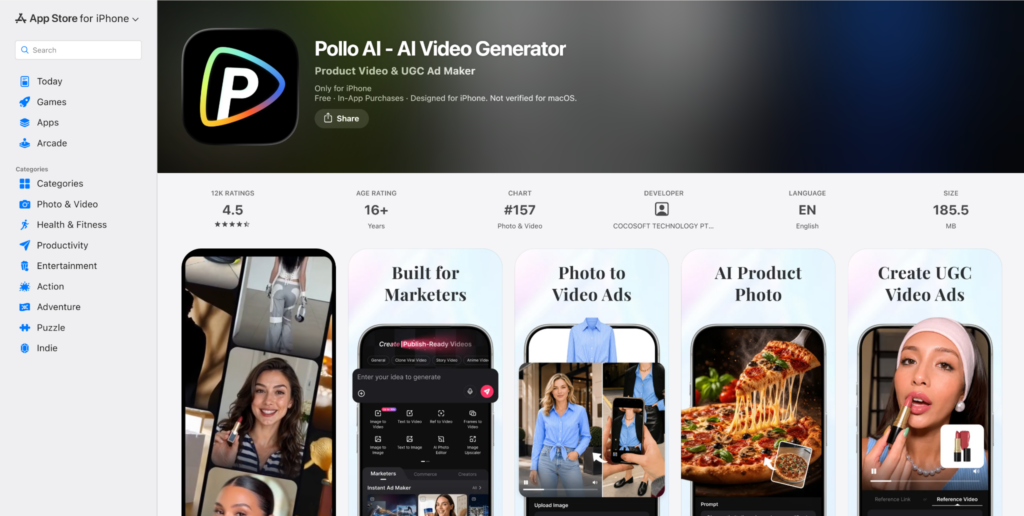
Among the platforms offering text to video AI, Pollo AI stands out for several reasons — especially for creators and marketers who need more than just a basic generation tool.
Pollo AI is structured around three studios: Creative Studio, Marketing Studio, and Commerce Studio. Text to video AI lives inside Creative Studio, alongside tools for image to video, AI image generation, avatar creation, and audio generation. Everything you need to create content is in one place.
What makes Pollo AI particularly strong is its multi-model approach. Instead of locking you into a single AI model, the platform offers access to multiple leading models through one interface. This matters because different models have different strengths. Having the choice means you can match the tool to the task — and get better results every time.
Marketing Studio lets you turn those generated videos into marketing materials. For anyone running campaigns, this integration saves significant time. Commerce Studio adds value for product-focused businesses, offering AI-generated product photography, showcase videos, and virtual try-on capabilities.
Pollo AI also has a mobile app, which means you can use it from your phone, which is a genuine advantage for busy professionals.
The Bottom Line
Text to video AI has moved past the experimental phase. It’s a practical, powerful tool that’s already changing how content gets made. The quality is real. The speed is unmatched. And the accessibility means anyone — regardless of budget or technical background — can produce video content that performs.
The creators and marketers who adopt this technology now will have a significant head start. Those who wait will find themselves playing catch-up in a landscape that’s already moved on.
Start with a sentence. Let the AI handle the rest. Tools like Pollo AI make that process seamless — and the results speak for themselves.