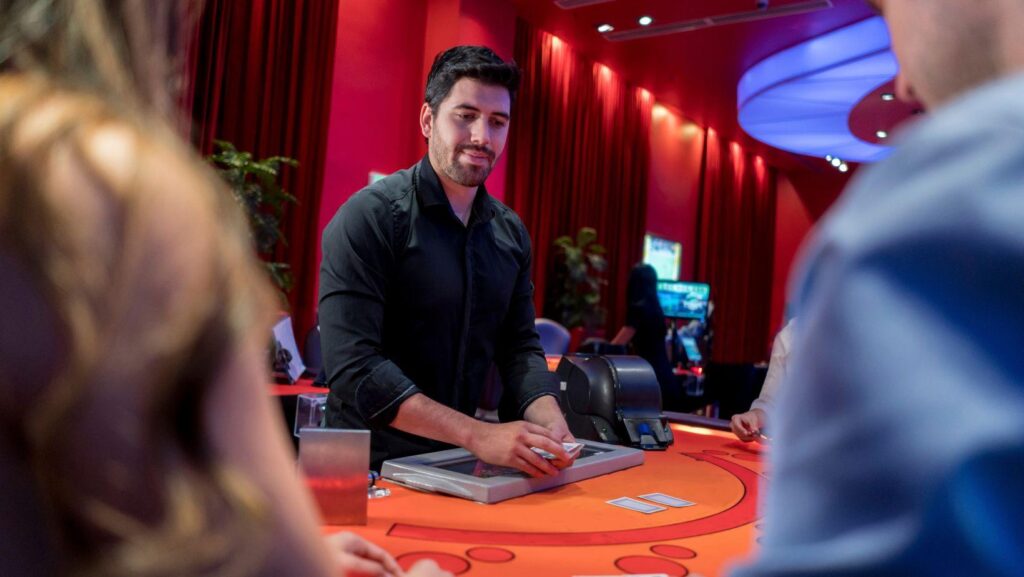
Live dealer games look simple from the player's side — a video feed, a real person, a bit of chat. What's actually happening behind that stream involves more moving pieces than most players ever think about, and understanding it helps explain why some platforms feel noticeably smoother than others.
The Studio Setup Behind the Stream
Most live dealer content doesn't come from a converted office room with a webcam bolted to a table. Serious operators run dedicated studios — purpose-built spaces with broadcast-grade cameras, usually three to five angles per table, professional lighting rigs, and soundproofing to keep the audio clean enough that a dealer's voice comes through clearly over a chat window full of players typing at once. Providers like Evolution Gaming and Pragmatic Play Live operate these studios at scale, streaming dozens of simultaneous tables to platforms across multiple markets, Canada included.
The dealer's side of the table typically has a screen showing the chat feed and betting activity, so they can respond to players by name and react to what's actually happening in the game rather than performing a scripted routine on a loop. Behind the scenes, a technical crew handles camera switching, lighting adjustments, and stream stability in something closer to a small TV production than a traditional casino floor. A single studio might run twenty or more tables simultaneously, each needing its own dedicated stream, its own dealer rotation schedule, and its own technical monitoring — which is a genuinely more complex operation than the polished end result on a player's phone screen suggests.
Crowngreen's live section draws from several of these established studio partnerships rather than running a single in-house setup, which is part of why the table variety on Crowngreen tends to span a wider range of game types and stake levels than a platform relying on just one provider relationship.
Optical Character Recognition Makes the Real-Time Data Work
The part players rarely think about is how a physical card or a spin of a real wheel becomes data a platform can process instantly. Optical character recognition (OCR) technology reads the cards or ball position as they're revealed and converts that into digital game data within a fraction of a second — that's how a live blackjack table can show a running total or a live roulette wheel can confirm a winning number almost the moment it lands, without a human manually entering results into the system after every hand.
This OCR layer is also what keeps live results provably fair in a way that's genuinely different from a digital slot. Since the outcome is read directly from a real physical event rather than generated by software, there's no random number generator to audit the way there is for a slot game — the fairness argument rests on the physical mechanics themselves, the visible dealer, and the transparency of watching an actual card get flipped or an actual ball land, rather than trusting an algorithm you can't see running in the background.
There's a fair bit of redundancy built into this system too. Most studios run the OCR recognition alongside a manual verification step, where a supervisor or pit boss figure monitors multiple tables and can flag a discrepancy if the automated reading and the visible outcome don't match. It's a small detail that rarely gets mentioned in marketing material, but it's part of why live dealer formats have earned a reputation for being harder to dispute than some players initially assume.
Latency and Connection Quality Matter More Than People Assume
A live stream depends on a stable, low-latency connection between the studio and the player's device, and this is where a lot of the actual quality difference between platforms shows up. Poor latency doesn't just look bad on screen — it can cause a bet window to close before an action registers, which is a genuinely frustrating experience during a fast-moving format like live blackjack where timing matters. Reputable platforms invest specifically in content delivery network (CDN) infrastructure to minimize this, routing video through servers geographically closer to the player rather than relying on a single centralized stream location that everyone connects to regardless of where they are.
Live lobby runs on this kind of CDN-backed setup at Crowngreen rather than a single-server stream, which is part of why table transitions and bet windows tend to stay responsive even during peak evening hours, when server load is highest across most platforms simultaneously. Anyone who's played live blackjack on a laggy connection knows exactly how much this matters — a half-second delay on a hit-or-stand decision can be the difference between a clean hand and a missed window entirely.
Mobile connections add another layer of complexity here, since cellular networks introduce more variability than a home wifi connection. Platforms that optimize specifically for mobile streaming — adaptive bitrate that adjusts video quality in real time based on connection strength, rather than forcing a fixed high-quality stream that stutters on a weaker signal — tend to hold up noticeably better for players connecting from a phone on the go rather than a desktop on stable broadband.
Why Some Tables Feel Better Than Others
Table quality differences between platforms usually come down to a handful of concrete, checkable factors rather than anything subjective. How many camera angles are actually in use, versus a single static shot that misses key moments. Whether the dealer is trained specifically for live-stream hosting — engaging with chat, maintaining pace, handling technical hiccups smoothly — rather than someone simply transplanted from in-person dealing without any streaming-specific training. And how quickly technical issues actually get resolved when they occur, since even the best setup occasionally has a stream hiccup or a table needing to briefly pause.
A platform that licenses tables from established providers like Evolution rather than running a budget in-house setup tends to show these differences clearly once you compare a few tables side by side for even ten minutes. The gap between a well-produced live table and a rougher one is usually obvious almost immediately — better lighting, steadier camera work, a dealer who's clearly comfortable performing for a stream audience rather than just going through mechanical motions.
What This Means for Choosing Where to Play
None of this technology is visible from a homepage screenshot or a promotional banner, which is exactly why it's worth actually testing a table directly before assuming all live dealer experiences are interchangeable. Camera quality, dealer responsiveness, and stream stability during a busy Saturday evening tell you more about a platform's real investment in this format than any marketing copy will. Crowngreen holds up well against this kind of direct comparison, largely because the underlying studio and CDN infrastructure choices were made with exactly these pain points in mind rather than treating live dealer as an afterthought bolted onto an existing slots-first platform.